
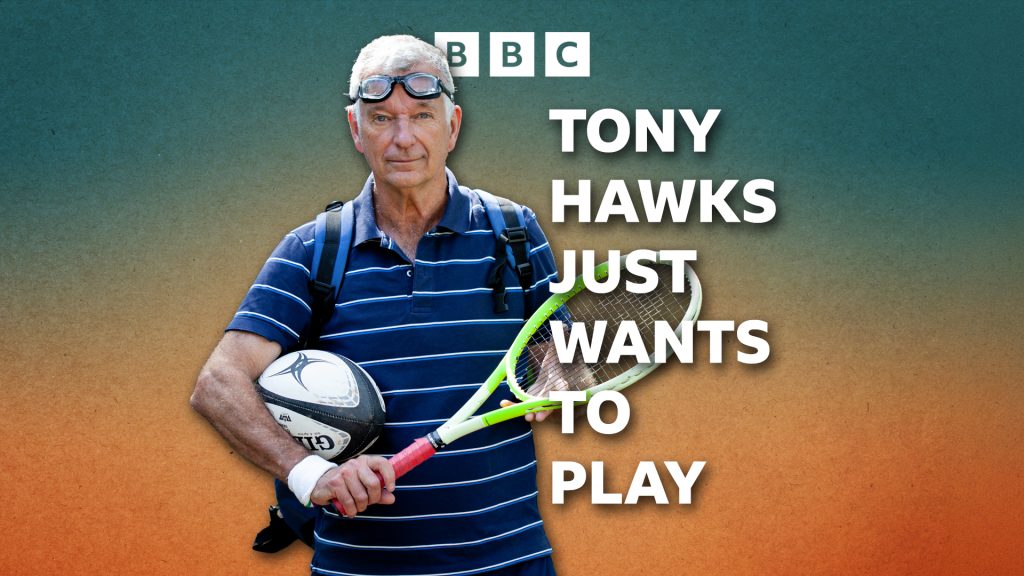
5 Part Series for BBC Radio 4
Across Britain, the places where we play, and our freedom to play in them, are changing. Join comedian Tony Hawks as he heads into parks and playgrounds, plunges into rivers, trudges across moors, and steps onto tennis courts and rugby pitches to understand why it has become so difficult to play in the UK today.
Blending humour, personal stories, and sharp social insight, this series explores how cost, class, and control are reshaping our relationship with play, and why that matters far beyond sport.
Tennis has been Tony’s passion since childhood. Coached by his father on free local park courts, he went on to become the second best player in the county. Looking back, Tony recognises how fortunate he was to grow up with easy, open access to the sport and how such opportunities are becoming harder to find today – with many public tennis courts now sitting behind gates, booking systems, and paywalls.
Using tennis as a starting point, Tony investigates a much bigger national story: what happens when everyday play becomes harder to access? From blocked footpaths and restricted wild swimming spots to shrinking playgrounds and streets dominated by traffic, the series explores the visible and invisible barriers stopping people from moving freely, feeling part of a community and playing spontaneously in public spaces.
Episode 1 – Padlocks and Strawberries
Access to play, sport and nature shouldn’t be taken for granted. Join comedian Tony Hawks as he explores the barriers shaping how we play in the UK, and why it matters to us all.
The Wimbledon Tennis Championships – there’s nothing quite like it. The strawberries, the (occasional) sunshine…and that glorious two-week window where the whole country suddenly remembers that ‘love’ means nothing. In this first episode, Tony is at the Wimbledon Championships, exploring Britain’s tennis culture and asking whether the game is truly accessible to everyone.
Through conversations with fans, players, coaches, and tennis historian Dr Robert J. Lake, this episode explores tennis’ long-standing image as an exclusive sport, shaped by its aristocratic roots, high coaching costs, and posh traditions. While Wimbledon’s famous Queue is often seen as an effort to expand access, many still point to barriers of cost, geography and culture. Tony looks at attempts to widen participation – from public park courts to the “Workers’ Wimbledon” movement of the 1930s, when the game was more widely shared. Racket in hand and inspired by stories such as Venus and Serena Williams’ beginnings on free public courts, Tony reflects on why tennis in the UK can still feel so out of reach today.
Episode 2 – Both Sides of the Court
Free tennis courts or better tennis courts? Turn up and play or book ahead and pay? When it comes to our public tennis courts, it seems we can’t have it all. In episode two, Tony continues his exploration of play and accessibility in Britain by focusing on a growing debate around public tennis courts: should they remain free and open, or become bookable, gated, and pay-to-use spaces in exchange for better facilities? Using tennis as a lens for wider questions about public space, community and participation, Tony investigates what happens when access to play becomes managed and controlled.
After finding locked tennis courts at his local park, Tony investigates the LTA’s £45 million Park Tennis Project, which has refurbished public courts across the UK. Some local councils say the funding has helped prevent courts from falling into decline, and supporters welcome the introduction of an hourly fee in return for cleaner, safer facilities and reliable booking systems.
In Exeter, however, the council chose not to join the scheme, keeping courts free and open without gates or online booking. Though worn, the courts remain busy with casual players and families. Critics argue booking systems can create barriers for beginners and lower-income users. Coach Mike Patterson says the courts remain a vital social space, while former Wimbledon champion Pat Cash warns that too many obstacles risk putting young people off the sport entirely.
Ultimately, this episode is not just about tennis. Tony reflects on how public spaces for play shape communities, support health, and encourage social connection. The central question becomes not simply whether courts should be free or well maintained, but how society can balance accessibility, safety and inclusion in the places where people come together to play.
Episode 3 – Off Limits
A padlocked gate, a stretch of barbed wire, a sign politely informing you that ‘trespassers will be prosecuted’. All the familiar clues that say you’re not meant to be here. And they’re turning up more and more in places that used to be open to everyone.
What happens when access to play starts shrinking everywhere, from wild places, green space, to our rivers, lakes, and to our cities? How easy is it really to move, explore, mess about, and just play in Britain today?
In this third episode, Tony heads to Dartmoor National Park, where right-to-roam campaigner Lewis Winks explains how most land is privately owned, even inside national parks, and how legal boundaries can block access to places most people assume are public. The debate extends to waterways, where confusing ownership and restrictive signage discourage wild swimming.
River campaigner Becca Drazin describes how efforts to improve water quality on Bristol’s River Avon have been limited by bylaws restricting swimming access, creating a cycle in which polluted rivers are harder to reclaim for public use. In cities and towns, Dr Michael Martin of the University of Sheffield argues that car-focused planning has reduced both the safety and accessibility of urban play spaces. Altogether, Tony finds that barriers to play are shaped by ownership, policy, pollution and urban design.
Episode 4 – Hidden Hurdles
So far, Tony has focused on the obvious obstacles that get in the way of us being more playful here in the UK: the padlocked gates, the barbed wire fences, the stern No Trespassing signs.
But in this episode, Tony is looking beyond all that – because things like gender, race, age, postcode, and socioeconomic background all shape your chances of playing, moving, and feeling like you belong. In episode four, Tony meets people navigating these unseen barriers.
At the University of Exeter women’s rugby team, coach Poppy Leitch says participation is growing after the success of the Red Roses in the Women’s Rugby World Cup in 2025. However, resources and role models still lag behind the men’s game. Players describe stereotypes around aggression, body image, and femininity that can push women out of sport.
Tony also meets Josh Adeyemi of Black Scottish Adventurers, who explains how people of colour can feel unwelcome in the countryside when they rarely see themselves represented there. Lack of transport, awareness of opportunities and confidence can all become barriers to access nature.
Finally, Play England director Eugene Minogue argues that children’s freedom to play has dramatically declined over generations, especially in lower-income areas where playgrounds are fewer and of lower quality. He warns that modern parenting, safety concerns and policy decisions are limiting children’s independence, turning play from a natural part of childhood into something more restricted and controlled.
Episode 5 – Game On!
In the final episode, Tony turns from the barriers to playing and having fun in Britain, to the communities creating open and welcoming public spaces where they can play freely. In Exeter, volunteers run weekly free community tennis sessions on public courts that remain accessible without gates or booking systems, bringing together people of all ages and backgrounds.
Tony also heads to the River Thames, where he bravely tries cold water swimming within the city. Meeting with campaigners swimming activists Chris Romer-Lee and Simon Griffiths, they discuss promoting safer public access to urban rivers and better water quality monitoring. This work challenges the assumption that city waterways are too polluted to use, and therefore should remain off-limits.
In Bristol, parents and play advocates temporarily close residential streets so children can safely play outside again, transforming traffic-dominated roads into lively communal spaces.
Across tennis courts, rivers and neighbourhood streets, it is clear that play cannot be just leisure, or a privilege for the few. It is about wellbeing, connection and community – and how ordinary people can come together to reclaim public space, making it somewhere safe to socialise, exercise and belong.